
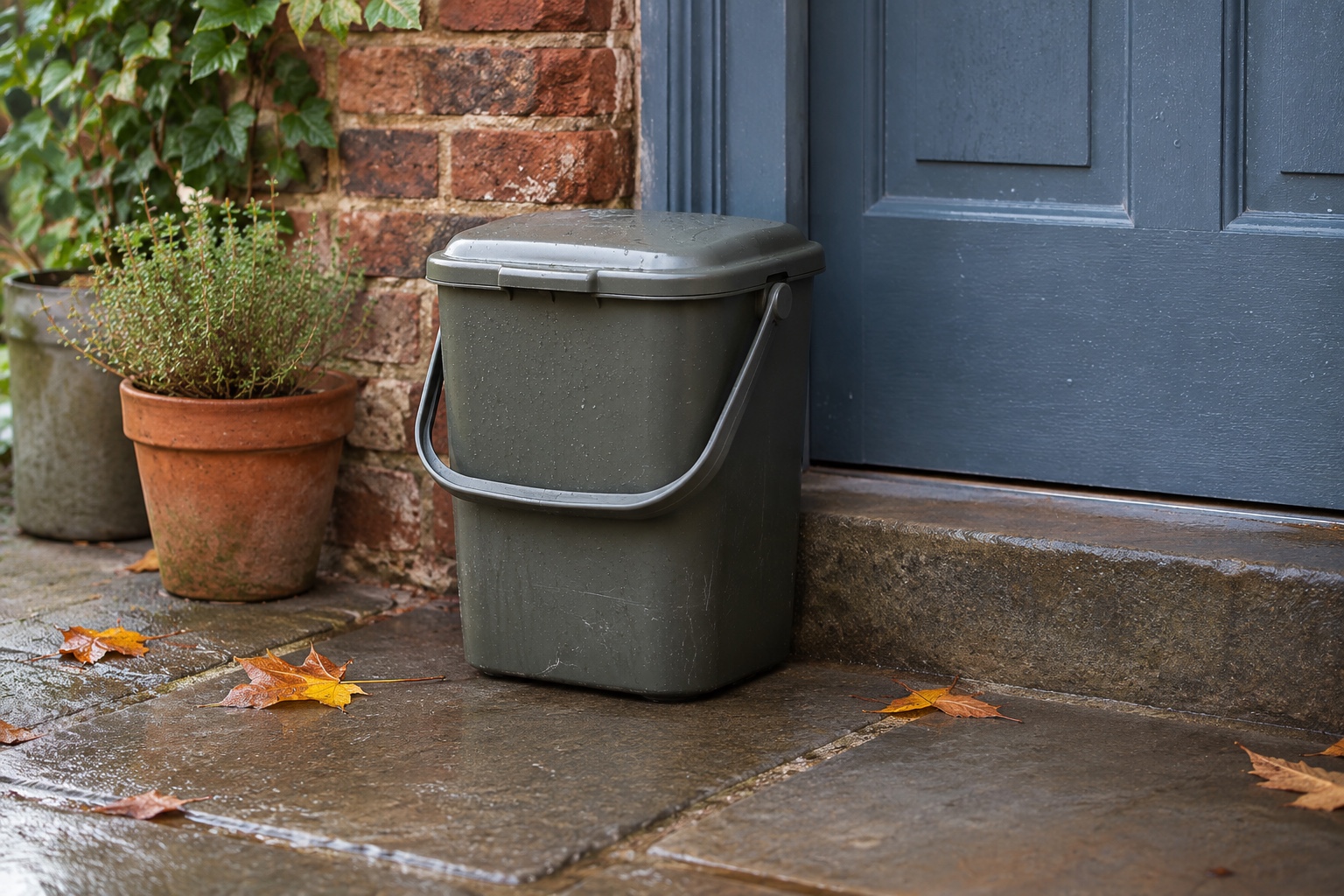
East Hampshire District Council in England collected more than 316 tonnes of household food waste in the first five weeks of its new weekly service. The service began on 5 October 2026, and the council published the five-week total on 12 November. It said the weight rose each week and attributed the latest peak to extra Halloween pumpkins. The figures give the district an early measure of how much material entered the new collection stream.
How the separate collection works
The council’s service guide says most households get a five-litre kitchen caddy and a 23-litre outdoor caddy that is emptied weekly. Residents who use communal bin areas get a kitchen caddy and access to a shared food waste bin. The same collection accepts banana skins and bones as well as uneaten food. Everything goes into the same weight total, so the published figure cannot show how much of it was edible before it was discarded.
The council sends the material to anaerobic digestion plants. The process can turn it into biogas and leave a material that can be used as fertiliser when it meets the required quality. The Department for Environment, Food and Rural Affairs’ guidance names anaerobic digestion as the preferred treatment for separately collected food waste. Its rules for England generally require weekly household food waste collection, with later start dates for some authorities under transition arrangements.
What to look for after the first five weeks
More residents setting out caddies could push the weekly weight up even if the amount of food each household discards stays steady. A holiday can change the weight again. The same council could get a clearer picture by tracking how many homes use the service and sampling how much food still goes into general rubbish. Comparing similar periods over time would help account for seasonal peaks.
To measure prevention, the district would also need to track how much edible food is discarded across both bins. For any city introducing a separate collection, those figures answer two different questions. The caddy total tells the operator how much it picked up for processing. A sustained drop in edible food across both bins, with no shift to another disposal route, would indicate that less food was being wasted in the first place.
Sources checked on 13 November 2026. Cover: AI-generated editorial illustration of a generic residential doorstep.
A good read is worth sharing.
Pass this story on to someone who would enjoy it.
The conversation 0
A thought, a question, a little food for thought. Join in — no account needed.
Loading the conversation…
Be the first to add a thought.