
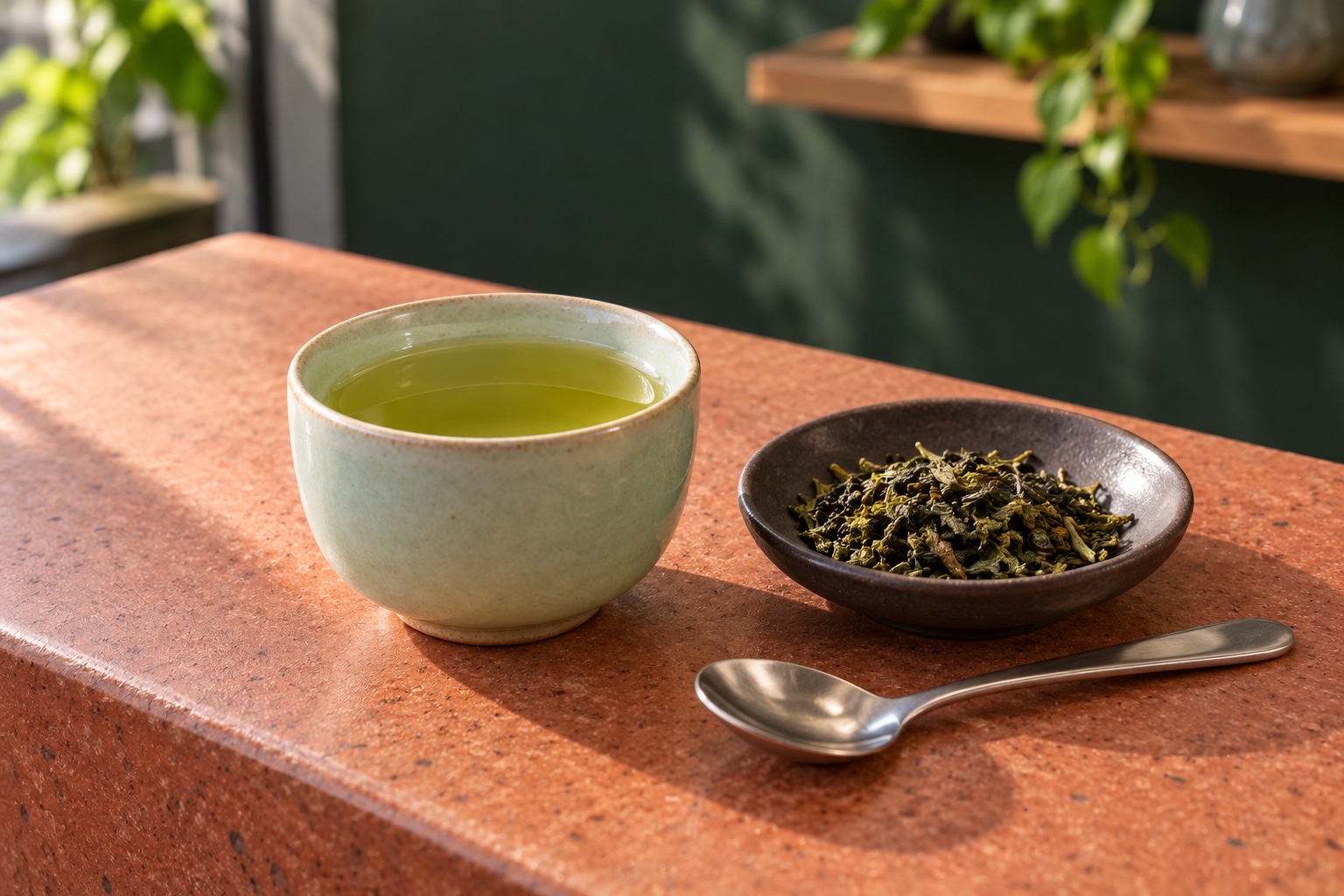
Food scientists have tested a combination of light, vibration and drying to change the aroma of machine-harvested green tea. Their study, published on 23 October 2026 in npj Science of Food, is available as peer-reviewed accepted research awaiting final editing.
Flavour begins before the kettle
Researchers used Wuniuzao leaves from one producer. During an eight-hour spreading stage, the combined treatment received auxiliary light throughout, with vibration during the first three hours; final drying was at 75°C. Comparisons included conventional spreading and vibration treatments with different drying temperatures.
Chemical analysis found more esters and terpenes in the combined-treatment sample. A trained ten-person panel gave it the highest floral and fresh aroma scores, alongside the highest umami and mellow taste scores, among the tested samples. The manuscript describes randomized sample presentation and repeated evaluations.
A promising result with a defined scope
This was one cultivar and source, with trained assessors rather than a broad consumer-preference survey. The proposed biological mechanisms still need direct confirmation. The 75°C figure describes a production drying condition; it should not be read as a new kettle setting.
A more useful conversation about tea
For someone choosing tea for a Dubai office break or a meal at home, the interesting question is what a flavour description actually promises. Would you enjoy a more floral cup, or do you prefer a quieter, grassy character? Those are personal preferences worth describing in ordinary words.
A useful follow-up to this research would ask whether the same approach performs consistently across harvests and whether everyday drinkers favour the result. Cost, energy use and practical production conditions would also deserve attention before judging its wider usefulness. The next worthwhile story would connect the processing experiment with those everyday questions.
Original AI-assisted food-science reporting. Sources checked on 25 October 2026. Cover: AI-generated editorial illustration of generic tea, not the study samples, equipment or a documented HAS product.
A good read is worth sharing.
Pass this story on to someone who would enjoy it.
The conversation 0
A thought, a question, a little food for thought. Join in — no account needed.
Loading the conversation…
Be the first to add a thought.