
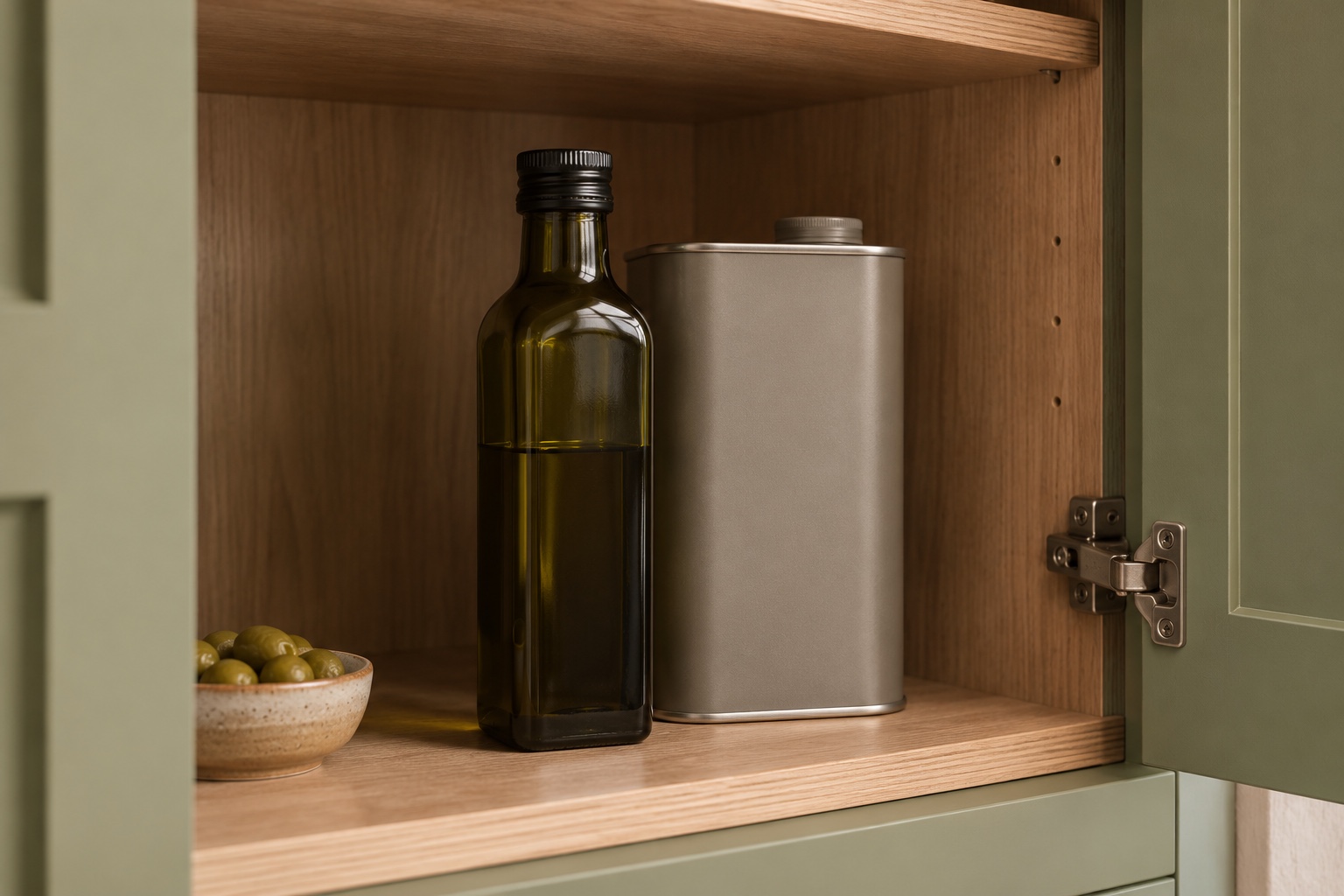
A bottle of extra virgin olive oil often ends up within reach of the hob. That makes it easy to pour over hummus, whisk into a salad dressing or add to a pan. In a compact Dubai apartment, the same shelf might warm up when you cook or catch sunlight in the afternoon. If you want the last spoonful to taste closer to the first, make the place where you use your oil a short stop. A closed cupboard elsewhere in the kitchen can be its home.
Find a shelf that stays shaded and cool
Look at the cupboard you have in mind after you have made dinner and again when the kitchen gets its strongest daylight. Is the shelf warm to the touch? Does it share a panel with an oven, or sit above the hob? A lower cupboard on the other side of the kitchen may be easier on the oil. A closed pantry shelf is a good option if it stays cooler than the worktop. Even a light-blocking tin benefits from being away from repeated heat exposure.
Light, heat and air all play a part in deterioration. The US Department of Agriculture lists those factors in its olive oil storage instructions for producers, where limiting air contact and keeping containers cool and dark help preserve quality. A separate controlled experiment on one Argentine virgin olive oil illustrates why conditions matter. Researchers compared samples after 76 days under several combinations of light exposure, temperature and air in the container. At the end of the test, warmer conditions generally led to larger changes in several quality measures. The researchers reported better stability with lower temperatures, darkness and a nitrogen-filled headspace. At home, pour what you need, put the cap back on and return the bottle to its cupboard. USDA olive oil inspection instructions · Controlled storage study
Buy for the way you actually pour
For one ordinary week, measure roughly how much of this particular oil goes into the pan, salad bowl and serving dishes. Divide the volume of a bottle you are considering by your week's use to see how long it would be open. At roughly 45 mL per week, a 250 mL bottle lasts around five to six weeks. A 500 mL bottle lasts about eleven. At 90 mL per week, the larger bottle lasts about five to six weeks. Those are shopping estimates you can adjust after a holiday or a change in your cooking routine.
If you only use this oil to finish dishes, the small bottle may suit you even when a large tin costs less per litre. If you use it most days, buying more can make sense. When a shop offers two smaller sealed bottles for a similar price, you can open the second after the first is finished. If you already bought a large container, work from it with the cap closed between pours and keep it in the cool cupboard. A smaller capped bottle can make serving easier if you refill occasionally. Keep the main container shaded too.
Look at the pack and how it closes
Think about light and air separately. Dark glass or an opaque tin helps shield oil from light. A cap that screws down firmly is useful once you start pouring. A 2026 study simulated 40 days of household use with one extra virgin olive oil. In that setup, a collapsing bag-in-box and a coated tin better preserved some quality measures than the particular green plastic bottle tested. The bag contracted as oil was dispensed. The experiment covered one oil, three packs and a set routine, so its results describe how those packs performed together with those storage conditions. Simulated household-use study
Keep track of the flavour you bought it for
Try a little of the oil on a spoon when you first open it. It gives you a reference for its aroma and flavour the next time you dress beans or spoon it over grilled vegetables. Depending on the oil, you might notice fruitiness, bitterness or a peppery finish. Write the opening date on the side or cap if you tend to have more than one bottle on the go. When the next bottle is due, the time it took to finish the previous one can guide your choice. Consider whether you still enjoyed its flavour towards the end. FAO on olive oil flavour and handling
Sources checked on 16 November 2026. Cover: AI-generated editorial illustration of olive oil stored on a shaded cupboard shelf.
A good read is worth sharing.
Pass this story on to someone who would enjoy it.
The conversation 0
A thought, a question, a little food for thought. Join in — no account needed.
Loading the conversation…
Be the first to add a thought.