
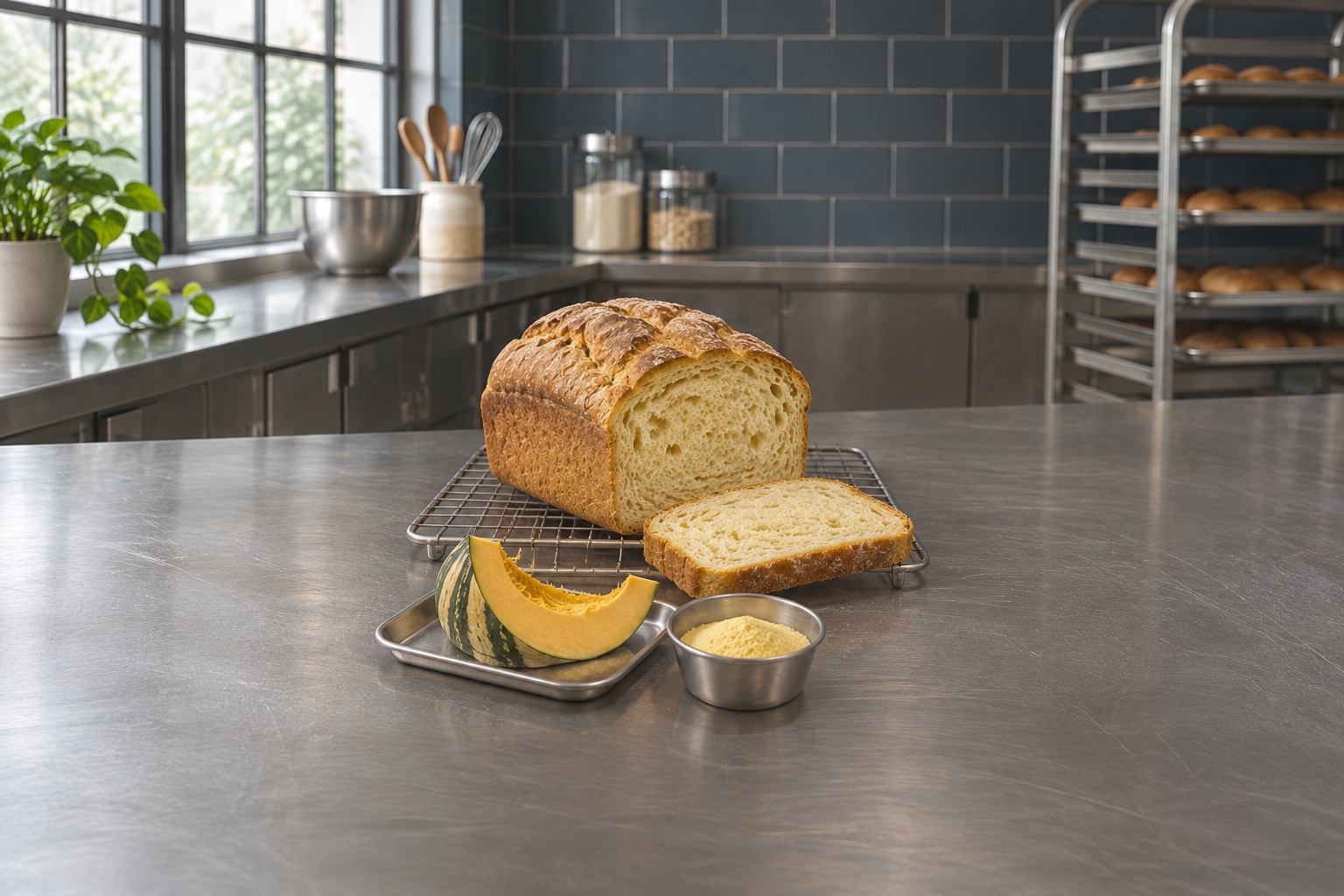
Researchers in Türkiye have tested whether the flesh left behind after pumpkins are harvested for their seeds can go into sandwich bread. In a study published on 13 November 2026, replacing 2.5% of the wheat flour by weight with dried, milled pumpkin flesh produced a loaf similar in size to the plain wheat loaf under the trial conditions. The experiment gives pumpkin processors and bakers a starting point for testing what they could do with the flesh. Scientific Reports study
A small amount went furthest
Meltem Türkoğlu and Kamil Emre Gerçekaslan used pumpkins from one grower in Nevşehir. They removed the peel and seeds, freeze-dried the flesh and ground it to a fine powder. Their test compared plain wheat pan bread with batches that replaced 2.5%, 5%, 10% or 20% of the wheat flour. Wheat made up most of the flour in every loaf.
The 2.5% loaf measured about 403 mL in volume against 398 mL for the plain loaf, and the study found no statistically significant difference. At 5% the loaf was slightly smaller. At 20% its volume was about 36% lower than the plain loaf’s. The tasting results showed a different threshold. Overall liking scores for the 2.5% and 5% batches did not differ significantly from those of the plain loaf, while the 10% and 20% batches scored lower. The 15 trained tasters were university staff and graduate students who received coded samples, so their ratings describe a small panel. Full paper, methods and results
What it would take outside the lab
Finding a use for flesh at the processor’s end could address food loss before it reaches a shop or home. The Food and Agriculture Organization distinguishes losses earlier in the supply chain from waste at retail, food service and household level. In this experiment, the researchers measured how bread behaved with the new ingredient. Any reduction in losses would need to be measured in a working supply chain. FAO overview of food loss
The study used a five-day freeze-drying process. For a seed processor and a bakery considering a joint trial, two practical questions are how much usable flour each delivery of flesh produces and what it costs to dry and mill. Repeating small batches across several deliveries would show whether the loaves stay consistent as the raw material changes. Those figures would help determine whether the idea works at bakery scale.
Sources checked on 15 November 2026. Cover: AI-generated editorial illustration of a sliced loaf, pumpkin flesh and flour at a fictional bakery.
A good read is worth sharing.
Pass this story on to someone who would enjoy it.
The conversation 0
A thought, a question, a little food for thought. Join in — no account needed.
Loading the conversation…
Be the first to add a thought.