
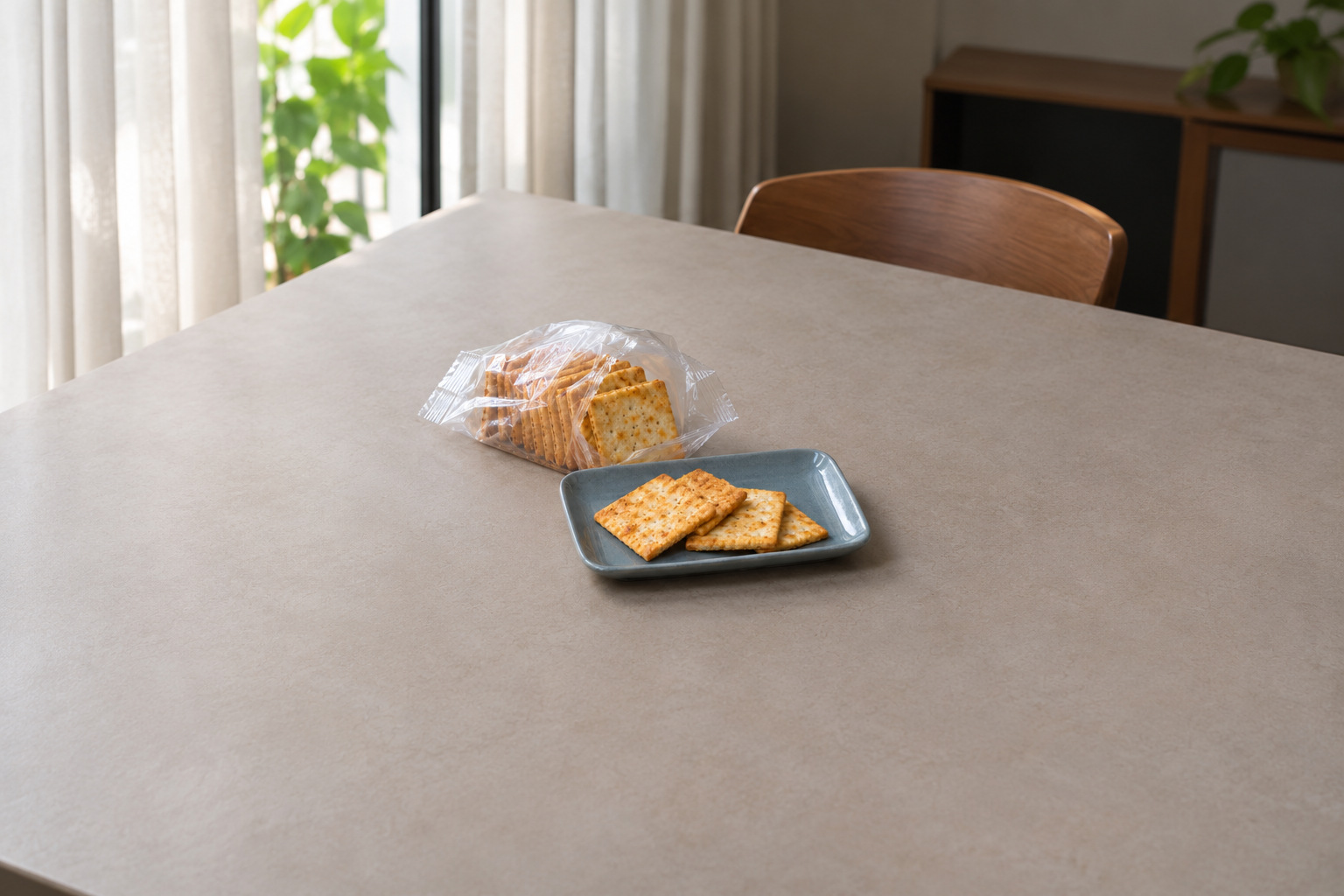
You pick up two packs of crackers while planning lunch. One displays a small number beside a serving; the other gives a larger number per 100 grams. Before either goes into the shopping basket, find out how much food each number describes. That small pause can turn a confusing comparison into a useful one, whether you are shopping in Dubai or unpacking groceries at home. The little print above a column deserves the same attention as the large figure that first catches your eye.
Give the number its unit
Start with the heading above the nutrition figures. In its UK food-label guide, the NHS describes information given per 100 grams or 100 millilitres, and sometimes per portion. It also points out that the manufacturer's portion may differ from yours. Read the unit and the amount together: a figure beside a small serving and a figure beside 100 grams answer different questions.
When comparing two similar crackers, find the same nutrient on both packs and use matching amounts. Keep grams with grams and millilitres with millilitres. Put the packs side by side rather than carrying one number in your head while searching for the other. If the basis is unclear, pause the comparison until you can identify it.
Separate the serving from the package
The NIH’s NIDDK calls the amount chosen at one time a portion. It distinguishes this from the serving listed on a US food label. A container can hold several servings; the label’s serving is not a personal recommendation. Check both serving size and servings per container before using the figures.
Think about how the pack will be used. A box opened for several lunches has a different role from a packet you plan to finish today. Keep that plan in mind while reading, rather than letting the size of the container make the decision for you. The useful information belongs to the food inside, not simply to the object in your hand.
Try one small calculation
Here is an invented arithmetic example, not the nutrition profile of a real product. Suppose a pack lists 6 grams of protein per 30-gram serving. A 45-gram portion is one and a half of those servings, so it would provide 9 grams of protein. The same figures expressed per 100 grams would be 20 grams of protein. All three numbers describe the same imaginary food at different amounts.
Try that calculation with one familiar item at home. Write the labelled amount, the amount you use, and the resulting figure on a scrap of paper. For information given per 100 grams, multiply the listed nutrient amount by the grams used, then divide by 100. Check that both amounts refer to the same form of the food before calculating.
Bring the label back to your meal
NIDDK also says you do not need to measure and count everything for the rest of your life. Use an occasional check to make a familiar amount easier to recognise.
For an ordinary lunch, decide what job the crackers are doing: accompanying soup, carrying a spread, or sitting alongside another dish. Set out the amount you intend to eat and return to the pack if you want to understand its contribution. That is a more concrete starting point than trying to judge lunch from the front of an unopened box.
On your next grocery trip, choose one comparison to practise. Find the amount behind the number, line up the same units, and connect the result with the food you plan to serve. Leave with a clearer understanding of that product and a simple reading habit you can use again.
Original AI-assisted editorial. Sources checked on 29 November 2026. Cover: AI-generated editorial illustration.
A good read is worth sharing.
Pass this story on to someone who would enjoy it.
The conversation 0
A thought, a question, a little food for thought. Join in — no account needed.
Loading the conversation…
Be the first to add a thought.